

How Lake.com activated supply through partner-led growth—and what it reveals about breaking the chicken-and-egg cycle
The Idea in Brief
- The Challenge: Two-sided marketplaces face a paradox: demand won’t materialize without supply, yet suppliers won’t join without proven demand. Most marketplaces fail because they attempt to solve both sides simultaneously.
- The Insight: Product marketing’s primary function is to sequence the solution, identifying which side enables the other, then building the collateral, partnerships, and enablement systems that unlock adoption at scale.
- The Approach: At Lake.com, we discovered that 90% of hosts were professional property managers, not individual homeowners. This insight transformed our distribution strategy from direct outreach to integration partnerships with property management systems, enabling one-click inventory synchronization. By creating partner-specific enablement materials, what we called the “money slide” workflow diagram, 90-second integration videos, and co-branded collateral, we reduced time-to-first-synced-listing and accelerated marketplace liquidity.
Every entrepreneur building a two-sided marketplace confronts the same existential dilemma. Travelers won’t book accommodations on a platform with limited inventory. Property owners won’t list their homes on a platform with no traffic. It’s the business equivalent of Catch-22.
Traditional approaches to this problem emphasize parallel growth: spend equally on both demand and supply acquisition, hoping critical mass materializes. But this spray-and-pray method burns capital and rarely achieves sustainable momentum. The companies that succeed recognize a fundamental truth: one side of the marketplace must come first, and product marketing determines which side—and how to activate it.
Sequencing the Solution: Why Supply Comes First
At Lake.com, a specialized marketplace for lakefront vacation rentals, we faced the classic cold-start problem. Our initial hypothesis followed conventional wisdom: build a beautiful search experience, attract travelers through content marketing and organic search, then use early demand signals to recruit property owners.
Within three months, the data told a different story. While we generated modest traveler interest, conversion rates remained anemic because our inventory was sparse and geographically fragmented. More revealing, when we analyzed our early host sign-ups, we discovered that approximately 90% self-identified as professional property managers operating portfolios of 10 to 200+ properties—not individual homeowners renting out their lake cottage.
This insight transformed our strategy. Rather than targeting thousands of individual homeowners, we could reach the same inventory count by partnering with dozens of property management companies and the software platforms they relied on. The path to supply density wasn’t direct-to-consumer marketing; it was B2B2C distribution through property management systems.
From Features to Problems: The Product Marketing Value Chain
Before we could build these partnerships, we needed to reframe how we communicated value. Too often, product teams fall into the feature-description trap: explaining what the product does without anchoring it to why it matters. This creates cognitive work for the user, who must translate capabilities into benefits.
Product marketing’s first responsibility is to complete this translation. Every feature requires a problem-benefit chain:
Feature → Problem it solves → Benefit the user receives
For instance, our initial product descriptions emphasized “7-step Listing Builder” as a feature. Reframed through the problem-oriented lens:
- Problem: Lengthy or confusing onboarding causes hosts to abandon the process
- Feature: Streamlined 7-step Listing Builder (reduced from 9 steps)
- Benefit: Faster time-to-live with complete, high-quality listings and reduced support burden
This seems straightforward, yet most B2B product marketing stops at feature enumeration. We mapped every platform capability—PMS integrations, pricing synchronization, amenity taxonomies, listing health scores—through this problem-benefit framework. The result was not a product tour but a narrative architecture that resonated with how property managers evaluated new distribution channels.
Partner-Led Growth: Making Integration Inevitable
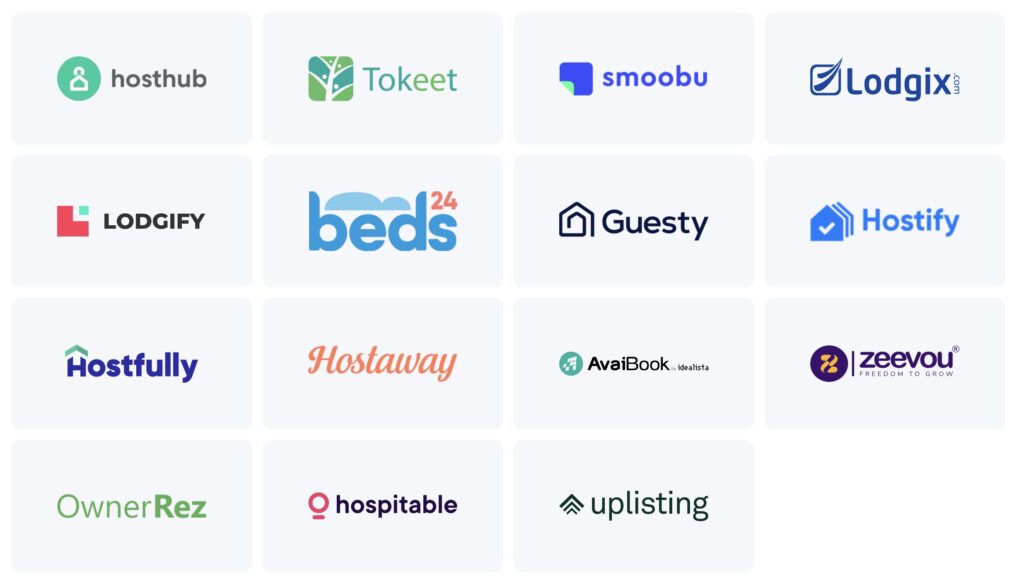
Professional property managers operate in a software ecosystem dominated by property management systems—platforms like Hostfully, Hostaway, Hostify, OwnerRez, and Lodgify that serve as their systems of record. These managers won’t adopt another dashboard or duplicate data entry across multiple channels. For Lake.com to succeed, we needed frictionless integration with their existing workflows.
This led us to pursue what we termed “partner-led growth”: treating PMS providers not as passive integration points but as active distribution amplifiers. The strategy rested on three foundations:
1. Clarify Differentiation
We positioned Lake.com to PMS partners as a complementary demand channel, not a competitor to broad OTAs. Our value proposition emphasized audience specificity: high-intent travelers planning family vacations to the lake, not generalist bookings. This positioning allowed PMS providers to present Lake.com as incremental revenue for their customers without creating channel conflict.
2. Reduce Integration Friction
Integration complexity kills partnerships. We invested heavily in two artifacts that made adoption nearly inevitable:
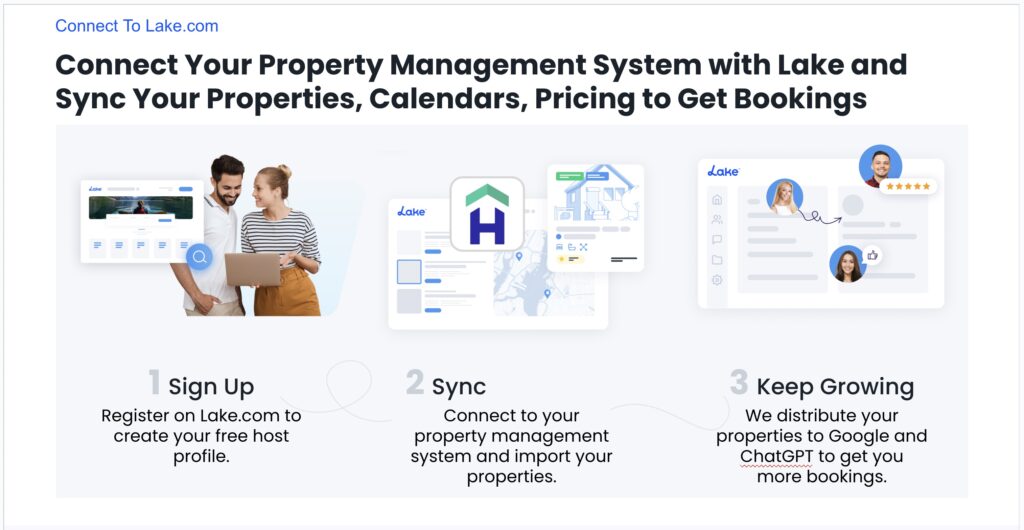
- The “Money Slide”: After hundreds of partnership presentations, including quarterly board meetings with private equity sponsors, I learned that every meeting ultimately hinges on one slide. For our PMS partnerships, I spent 90 minutes refining a single workflow diagram that mapped the complete integration journey—from a manager clicking “Connect to Lake.com” in their PMS through OAuth authorization, bulk import, validation, synchronization, and publishing rules. In 30-minute onboarding calls, we spent 20 minutes on this single slide. It aligned product, customer success, and commercial stakeholders instantly because it answered the only question that mattered: Who does what, when?
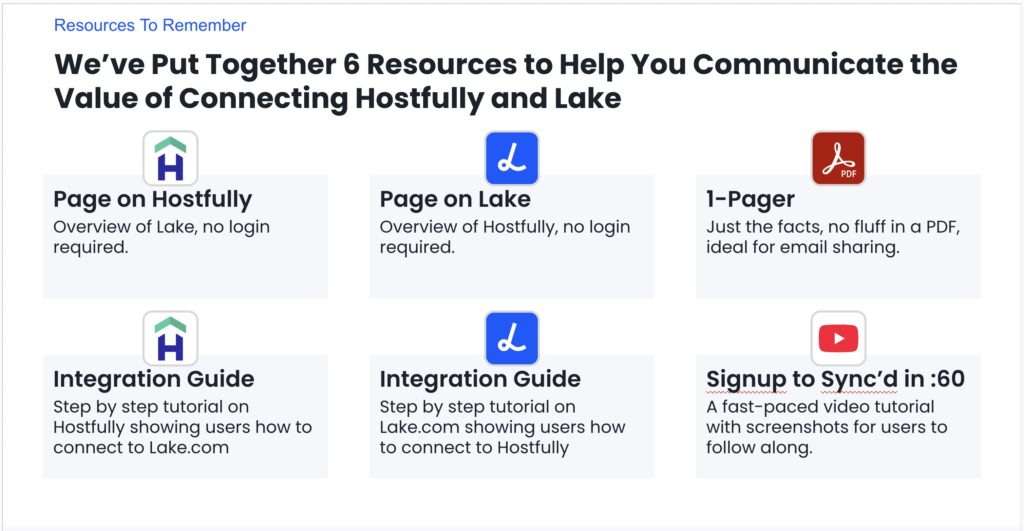
- Turnkey Enablement Materials: Integration requires more than technical documentation. We created co-branded one-pagers that PMS customer success teams could share in Slack channels, step-by-step guides written for CSMs who had never completed the integration themselves, and six 90-second video demonstrations showing “sign-up to synced” for each PMS platform.
3. Enable the Enablers
The hidden leverage in partner-led growth lies in enabling the humans who enable integration. PMS customer success teams become force multipliers if you equip them properly. We conducted live enablement sessions with CSM teams, turning them into advocates who understood both the why (positioning, differentiation) and the how (specific workflow steps). This human layer—often overlooked in purely technical integration strategies—determined whether integrations languished at 10% activation or scaled to 60%+ attachment rates.
Operationalizing Excellence: The Product Marketing Bill of Materials
Strategic clarity means nothing without execution discipline. We developed what we called the Product Marketing Bill of Materials—a comprehensive set of assets required to activate partnerships at scale:
Core Collateral:
Platform one-pagers, partnership pitch decks (anchored on the money slide), integration quick-start guides, FAQs addressing authorization and data ownership, searchable help-center articles, and 90-second video micro-demos for each PMS integration.
Internal Enablement:
Narrative briefs mapping problem-to-value-to-feature for sales and CS teams, message maps segmented by manager portfolio size, and objection-handling libraries tied to specific integration workflows.
Operating Cadence:
30-minute partner onboarding sessions structured as 5 minutes of context, 20 minutes on the money slide, 5 minutes defining next steps. Bi-weekly integration stand-ups focused on exception patterns rather than status updates. Quarterly business reviews presenting impact metrics meaningful to partners—activation rates, time-to-first-inquiry, customer satisfaction—not vanity metrics like total connected listings.
Measuring What Matters: Leading and Lagging Indicators
Product marketing success demands measurement rigor. We instrumented three layers of metrics:
Supply Acquisition (Leading Indicators):
Listing Builder completion rate, integration start rate, integration completion rate, time-to-sync. These revealed friction points before they compounded.
Quality Signals:
Listing health scores (photo quality, amenity completeness, calendar freshness), error-free sync rates. Volume without quality degrades marketplace trust.
Outcome Metrics (Lagging Indicators):
Active listings, time-to-first-inquiry, search-to-inquiry conversion, partner attach rates (percentage of PMS customers connecting to Lake.com), CS enablement adoption (internal shares of collateral), help-center self-solve rates versus support tickets.
The last category proved particularly revealing. When help-center self-solve rates exceeded 70%, we knew our enablement materials achieved their purpose: making integration so obvious that human intervention became optional.
The AI Amplification Frontier
Product marketing currently operates as a craft function—individuals refining collateral through iteration and judgment. Artificial intelligence is poised to transform this from craft to industrialized scale.
The next generation of product marketing will leverage AI to:
- Generate personalized collateral: Create partner-specific one-pagers dynamically, pulling in each PMS’s logo, data connections, and top three mutual value propositions.
- Auto-author integration documentation: Parse API specifications to output step-by-step guides with screenshots generated from sandbox flows, updated automatically as endpoints evolve.
- Score content quality continuously: Apply computer vision to assess listing photos, natural language processing to grade descriptions against traveler search intents, and automated prompts for missing information.
- Produce dynamic workflow diagrams: Generate “money slides” customized per partner—reflecting their specific data flows, error-handling protocols, and SLAs—maintained as integration details change.
This isn’t speculative. Early implementations of these capabilities exist today. What separates leaders from laggards will be organizational readiness to deploy AI where it creates leverage—repetitive personalization at scale—while preserving human judgment where it matters most: choosing the one idea that earns the right to hold the room.
Broader Implications: The Product Marketing Mandate
The Lake.com experience reveals three lessons applicable beyond vacation rental marketplaces:
First, solve the sequencing problem before the scaling problem. Parallel investments in both sides of a two-sided marketplace dissipate resources. Rigorous data analysis, not assumption, should determine which side enables the other. In our case, recognizing that professional property managers, not individual owners, comprised 90% of supply transformed distribution strategy from consumer marketing to B2B partnerships.
Second, feature-oriented communication fails; problem-oriented communication succeeds. Users don’t care about your product’s capabilities. They care about their problems. Product marketing must translate every feature through the lens of pain relieved and benefit delivered. This discipline creates messaging that resonates because it mirrors how buyers actually evaluate solutions.
Third, partnerships scale only when you enable the humans inside your partners. Technical integrations are necessary but insufficient. Real adoption depends on customer success teams, account managers, and implementation specialists inside partner organizations. Equipping these teams with simple, clear, copy-ready materials—the one-pagers, the workflow diagrams, the 90-second videos—determines whether partnerships generate 10% attachment or 60%+ attachment.
The product marketing function in two-sided marketplaces is fundamentally about collapsing friction—between value and comprehension, between integration and activation, between partners and their customers. Companies that master this function don’t just survive the cold-start problem. They turn it into competitive advantage, building moats through operational excellence that would-be competitors struggle to replicate.
As marketplaces proliferate across industries—from labor (Upwork) to transportation (Uber) to real estate (Zillow)—the principles remain constant. Sequence deliberately. Communicate clearly. Enable ruthlessly. Measure rigorously. And recognize that in platform businesses, product marketing isn’t a support function. It’s the function that determines whether your marketplace achieves liquidity—or languishes in the cold-start trap.