

The winning model in waterfront travel is not control of assets, but coordination of interactions
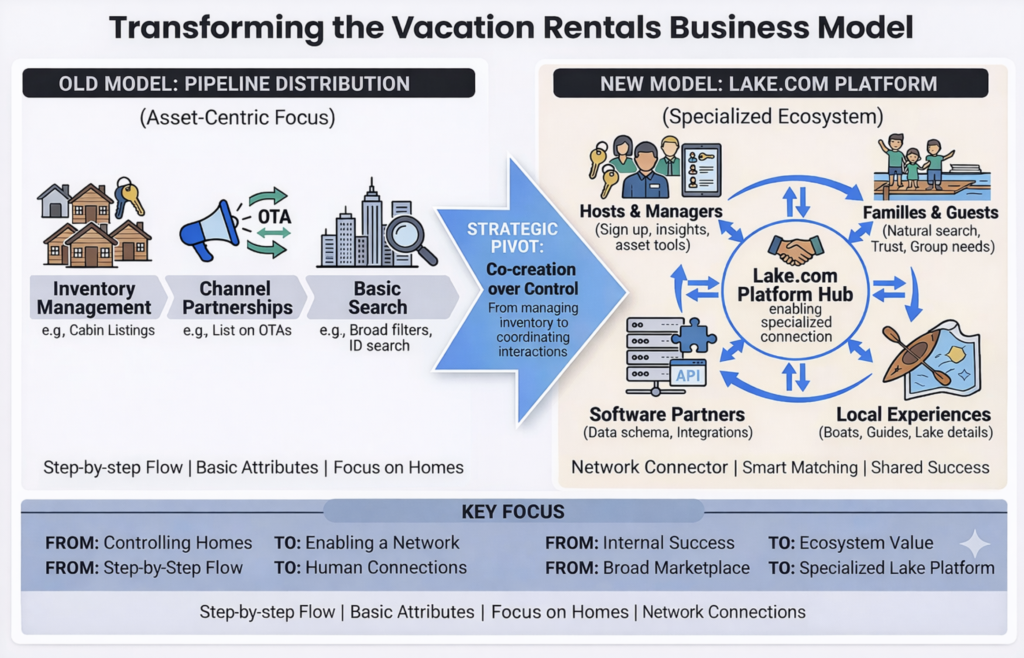
In travel, many companies still operate with a pipeline mindset.
They optimize what they control, improve what they own, and measure success by the efficiency with which inventory moves through a funnel.
That model works when the business owns the product. It works far less well when value is created by coordinating the messy middle of the traveler journey and fragmented decisions among hosts, guests, software partners, and local destinations.
Lake.com is being built on a different premise. We do not own cabins, cottages, docks, or marinas. Our role is to organize a specialized market for water-based vacations, connecting homeowners and property managers with families seeking lake houses, beach houses, luxury villas, and nearby experiences.
The mission? The help families experience God’s creation.
The strategic question is not how to manage more inventory. It is about enabling more high-quality interactions. That is the essence of the shift from pipeline thinking to platform thinking.
Waterfront travel is not a generic lodging category, which is why horizontal logic breaks down
This distinction matters because waterfront travel is not just another slice of lodging. It is a fragmented, intent-rich category where discovery is often harder than supply.
Lake.com’s own materials clearly frame the problem. Legacy OTAs bury waterfront homes among millions of urban listings. Guests scroll through hundreds of generic filters, yet still cannot search by the things that actually matter on the water:
- Dock access
- Boat launch
- Water depth
- Shoreline type
At the same time, hosts face slow onboarding and fragmented supply activation because the known inventory is often locked in property management systems.
In that setting, the operating problem is not simply distribution. It is coordination.
Platform logic wins when the company reduces friction between the two sides of the market
A platform creates value differently from a pipeline. A pipeline pushes owned or controlled inventory through a process. A platform reduces friction so that independent participants can find one another, trust one another, and transact more efficiently.
For Lake.com, that means combining content + marketplace into a single operating system.
Content helps demand take shape. Marketplace functionality converts that intent into bookings. The two are not separate. They are interdependent parts of the same system.
| Pipeline logic | Platform logic |
|---|---|
| Optimize owned inventory | Improve third-party participation |
| Treat content as marketing | Use content to improve matching |
| Measure funnel efficiency | Measure interaction quality |
| Control supply tightly | Set standards that make supply usable |
| Win by scale of assets | Win by quality of coordination |
That is the deeper strategic architecture Lake.com is moving toward.
Demand does not begin with a SKU; it begins with messy intent
Travelers rarely start with a property ID. They start with an aspiration: a long weekend on a quiet lake, a family reunion with a private dock, or a pet-friendly cottage within driving distance.
Traditional search forces the user to translate those desires into filter logic. Lake.com’s emerging product model assumes the opposite: users should be able to express intent in natural language, receive a curated shortlist that explains trade-offs, and be routed quickly to detail pages.
That is why our upcoming Lake Chat product is so important. Internally, the product vision is explicit that success should not be measured by chat engagement alone, but by movement from conversation to shortlist, to property listing page views, to availability checks, to booking.
In other words, the conversational layer matters only insofar as it improves marketplace conversion.
In a platform, content is not top-of-funnel marketing; it is part of the matching engine
In a pipeline model, content often sits upstream as awareness or inspiration. In a platform model, content is part of the matching mechanism itself.
Lake.com’s deep taxonomy across more than 7,000 destinations, along with lake-specific and regional metadata across 500,000 data points, is not merely editorial differentiation. It is a structured demand formation.
When guests articulate what they want, the data structure helps the platform interpret intent with greater precision. That improves match quality, lowers search cost, and increases the probability of repeat use.
This is a meaningful point of differentiation from horizontal OTAs. Lake.com is not simply showing more supply. It is trying to make water-based demand more legible and ultimately more accessible.
The supply side works best when participation is attractive, not burdensome
The second advantage of platform thinking appears on the supply side. Pipelines tend to over-control supply because they behave as though inventory were owned. Platforms win when they make external supply more usable, trustworthy, and economically attractive.
Lake.com’s current model reflects that logic:
- 10% host fee
- 0% guest fee
- $499 annual listing option
- One standardized cancellation framework
- Merchant-of-record protections
- PMS integrations that synchronize listings, pricing, and availability
These are not back-office details. They are participation incentives. The platform becomes more valuable as it becomes easier for hosts and property managers to join, stay synchronized, and trust the economics of participation.
The danger is importing pipeline behavior into a platform business
This is the subtle tension the management team has to navigate.
Vertical platforms often win early by curating tightly. But there is a difference between curation and control. If Lake.com begins to act as though it owns supply—by over-specifying standards, slowing onboarding, or curating so heavily that ecosystem breadth suffers—it risks importing pipeline inefficiencies into a platform business.
The goal is not to control every listing. The goal is to define the rules, trust signals, and data standards that allow the best interactions to scale.
That is a very different management posture.
Trust infrastructure matters as much as traffic because trust is what compounds
In a marketplace, more traffic is useful only if the underlying interactions remain reliable. Lake Chat’s internal roadmap makes that point directly.
Our guardrails include:
- Price and availability accuracy
- Hallucination or generic-response rate
- User-reported mismatch
- Structured property listing details
- Consistent policies across surfaces
Those are not merely product metrics. They are platform metrics.
You see, in marketplaces, trust compounds. Each reliable interaction lowers the cost of the next. Each mismatch does the opposite.
If conversational discovery is going to become a meaningful booking surface, recommendations must remain grounded in inventory truth.
Lake.com’s leverage comes from orchestrating discovery, trust, and transactions more effectively than horizontal incumbents
The economics support this model. Lake.com reports 40,000 property listings, 125,000 monthly unique visitors, and is pacing for 2 million visitors this year, with a documented 47 percent visibility in AI-generated vacation-rental results in the United States, and six live PMS integrations with six more in development. Its roadmap then follows a platform sequence: build supply first, generate demand next, and position for agent-driven distribution after that.
That matters because the business does not need to own the underlying assets. Its leverage comes from improving discovery, strengthening trust, and making transactions easier within a specialized category.
The real prize is becoming the default coordination layer for vacations by the water
The most important implication is geographic and operational. Platform power is rarely abstract. It is usually built cluster by cluster, where supply density, content depth, and user intent reinforce one another.
Seen through that lens, Lake.com is not simply building another travel marketplace. It is building a specialized coordination layer for vacations by the water.
That requires discipline. In fragmented categories, the next wave of advantage will not come from controlling more assets. It will come from structuring participation, reducing friction, and making complex decisions easier for both sides of the market.
The prize is not inventory. It is becoming the system through which the market reliably interacts. For Lake.com, the challenge now is to prove that in waterfront travel, the winning model is not pipeline efficiency, but platform orchestration.